
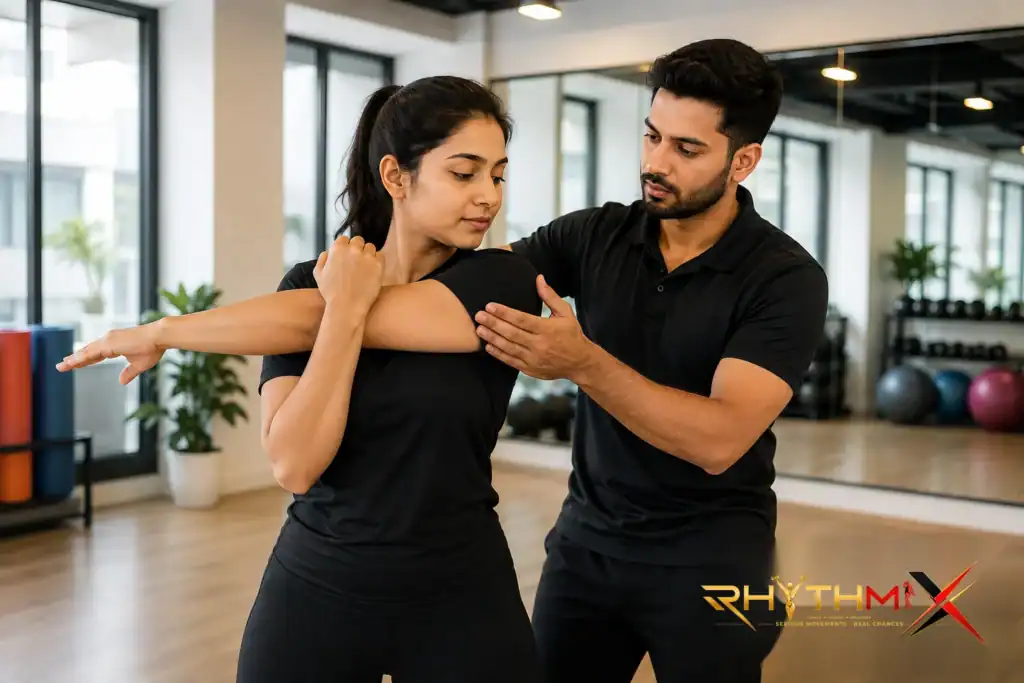
Shoulder Mobility Exercises: 7 Powerful Moves to Free Stiff Shoulders
Shoulder stiffness can make simple things feel difficult.
Reaching for something on a shelf. Wearing a shirt. Lifting your arm during a workout. Doing dance movements with clean arm lines. Sitting at a desk for hours and suddenly feeling like your shoulders have become tight, heavy, or blocked.
This is where shoulder mobility exercises can help.
But let’s make one thing clear first. Shoulder mobility is not about forcing your arm behind your head, copying advanced athletes, or doing random stretches from the internet. Good shoulder mobility exercises should feel controlled, comfortable, and useful. They should help your shoulder move better, not push your body into pain.
In this guide, you will learn what shoulder mobility actually means, why shoulders often feel stiff, how mobility is different from stretching, and which 7 beginner-friendly moves you can try safely. You will also get a simple 10-minute routine, common mistakes to avoid, and clear signs for when you should stop and get professional help.
This article is for general fitness and educational purposes. It is not a diagnosis or a personal medical rehabilitation program. If you have sharp pain, recent injury, numbness, severe weakness, surgery history, frozen shoulder, or a diagnosed shoulder condition, speak with a qualified healthcare professional before trying exercises.
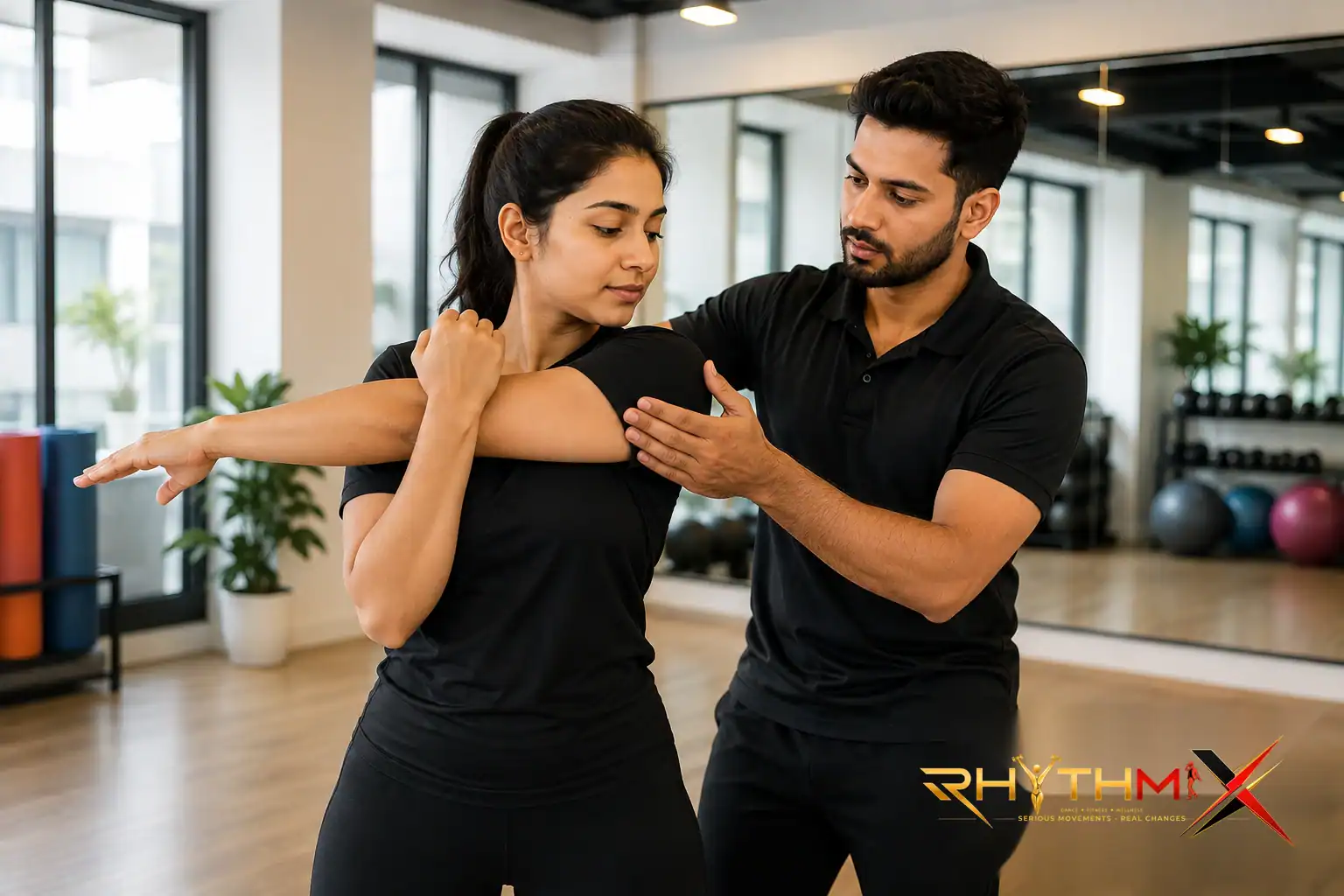
What Shoulder Mobility Means
Shoulder mobility means your shoulder can move through a useful range of motion with control.
That last part is important: with control.
Many people think mobility means “how far can I stretch?” But shoulder mobility is not only about flexibility. It is about how well your shoulder joint, shoulder blade, upper back, chest, neck area, and arm work together during movement.
For example, when you lift your arm overhead, the shoulder joint moves. But the shoulder blade also needs to rotate. The upper back should allow movement. The rib cage should stay controlled. The neck should not become tense. If one part is stiff, weak, irritated, or poorly controlled, the whole movement can feel restricted.
That is why the best shoulder mobility exercises usually include more than stretching. Some drills gently open the chest. Some teach shoulder blade control. Some prepare your shoulder before a workout. Some help you understand how your neck, upper back, and shoulder move together.
Recent rehabilitation guidance also supports active exercise, motor control, and resistance training for many shoulder-related conditions, but it does not say one fixed routine works for everyone. The 2025 JOSPT clinical practice guideline for rotator cuff tendinopathy recommends active rehabilitation that may include motor-control or resistance exercises [https://www.jospt.org/doi/10.2519/jospt.2025.13182].
So the honest goal of this article is simple:
These shoulder mobility exercises may help you practise smoother, more comfortable movement if your shoulders feel mildly stiff from inactivity, posture habits, training, or general tightness. They are not a guaranteed treatment for injury or disease.
Shoulder Mobility vs Shoulder Stretching
Shoulder stretching and shoulder mobility are related, but they are not exactly the same.
Stretching usually focuses on lengthening a muscle or holding a position. For example, holding a doorway chest stretch for 30 seconds is a stretch.
Mobility focuses on usable movement. It asks: can your shoulder move through a range with comfort, strength, awareness, and control?
A simple way to understand it:
Flexibility asks: Can your body reach the position?
Mobility asks: Can your body reach the position with control?
This is why shoulder mobility exercises for beginners should not only include passive stretches. They should include movements like wall slides, arm circles, band pull-aparts, and stick or towel pass-throughs.
Healthline’s shoulder mobility guide also separates mobility and flexibility, which matches how many trainers and rehab professionals explain this topic [https://www.healthline.com/health/shoulder-mobility-exercises].
For daily life, dance, workouts, and personal training, mobility is often more useful than stretching alone.
Why Do Your Shoulders Feel Stiff?
Shoulders can feel stiff for many reasons. Sometimes the reason is simple. Sometimes it needs professional assessment.
Common non-diagnostic reasons include long sitting hours, mobile phone use, laptop work, weak upper back muscles, tight chest muscles, poor warm-up before workouts, repeating the same movement again and again, stress, shallow breathing, and lack of overhead arm movement.
For dancers and fitness beginners, shoulder stiffness can show up during arm styling, floorwork, push-ups, planks, overhead reaches, dance fitness moves, or even simple warm-up movements. When the shoulder does not move freely, the neck, back, or lower body may start compensating.
For office workers, the problem is often not one single bad posture. It is staying in one position for too long. Your body likes movement. If your shoulders only move in small daily ranges, they can start feeling restricted when you suddenly ask them to reach, lift, rotate, or support your body weight.
This is why shoulder mobility exercises at home can be useful as a regular movement habit. You do not need to wait until your shoulder feels completely stuck. A few minutes of controlled movement can help you maintain awareness, comfort, and confidence.
Before You Start Shoulder Mobility Exercises
Before doing any shoulder mobility exercises, follow this rule:
Move in a comfortable range. Do not force pain.
A mild stretch or light effort is fine. Sharp pain is not. A gentle warm feeling is fine. Numbness or tingling is not. Feeling your muscles work is fine. Feeling like your shoulder is catching, pinching, or giving way is not something to ignore.
AAOS shoulder conditioning guidance advises that exercise programs should not cause pain and that people should speak with a doctor or physical therapist when exercising after injury or for a specific condition [https://orthoinfo.aaos.org/en/recovery/rotator-cuff-and-shoulder-conditioning-program/].
Do not use this routine as your personal plan if you have:
- Recent fall or accident
- Shoulder dislocation
- Severe pain
- Sudden loss of movement
- Arm weakness
- Numbness or tingling
- Shoulder surgery history
- Frozen shoulder diagnosis
- Rotator cuff tear diagnosis
- Pain that is getting worse
NHS shoulder pain guidance says urgent help may be needed if there is sudden very bad pain, difficulty moving the arm, or a shoulder that looks out of place or changed in shape [External Link: https://www.nhs.uk/symptoms/shoulder-pain/].
For general mild stiffness, start slow. These are beginner-friendly shoulder mobility exercises, not a flexibility competition.
7 Shoulder Mobility Exercises for Beginners
These 7 shoulder mobility exercises are selected for beginners because they are simple, practical, and easy to scale.
You do not need a gym for most of them. Some use a wall, towel, stick, or light resistance band. The goal is not to perform the hardest version. The goal is to find the version your body can control without pain.
1. Shoulder Rolls
Shoulder rolls look basic, but they are a good starting point because they gently move the shoulder blade area and help you become aware of tension.
How to do it:
Sit or stand tall. Let your arms relax by your sides. Slowly roll your shoulders upward, backward, downward, and forward in a smooth circle. Do 8 to 10 circles backward. Then reverse the direction and do 8 to 10 circles forward.
Keep your jaw relaxed. Breathe normally. Do not rush.
What it helps with:
Shoulder rolls can help reduce the heavy, tight feeling many people get after sitting for long hours. They also prepare the shoulder before other mobility exercises.
Make it easier:
Do smaller circles while sitting.
Make it harder:
Slow the movement down and focus on smooth control.
Common mistake:
Shrugging aggressively and moving too fast.
Safety cue:
Stop if you feel sharp pain, dizziness, numbness, or symptoms travelling down the arm.
2. Arm Circles
Arm circles are one of the easiest shoulder mobility exercises at home. They are useful before workouts, dance practice, or any activity where your arms need to move freely.
How to do it:
Stand tall with your arms out to the sides. Start with small circles. Move slowly for 20 to 30 seconds. Then reverse direction. As your shoulders feel warmer, you can make the circles slightly bigger, but only if it feels comfortable.
What it helps with:
Arm circles can prepare the shoulders for movement, improve awareness, and warm up the joint area before more active work.
Make it easier:
Keep the circles small and bend your elbows slightly.
Make it harder:
Make the circles larger, but keep them controlled.
Common mistake:
Swinging the arms wildly without control.
Safety cue:
Do not force large circles if your shoulder feels pinchy, unstable, or painful.
This is a good warm-up movement before dance workouts, gym sessions, or personal training. You can also connect this idea naturally with your article on dance workout benefits
3. Wall Slides
Wall slides are one of the best shoulder mobility exercises for beginners because they teach controlled overhead movement.
They also make you aware of your ribs, upper back, and shoulder blades.
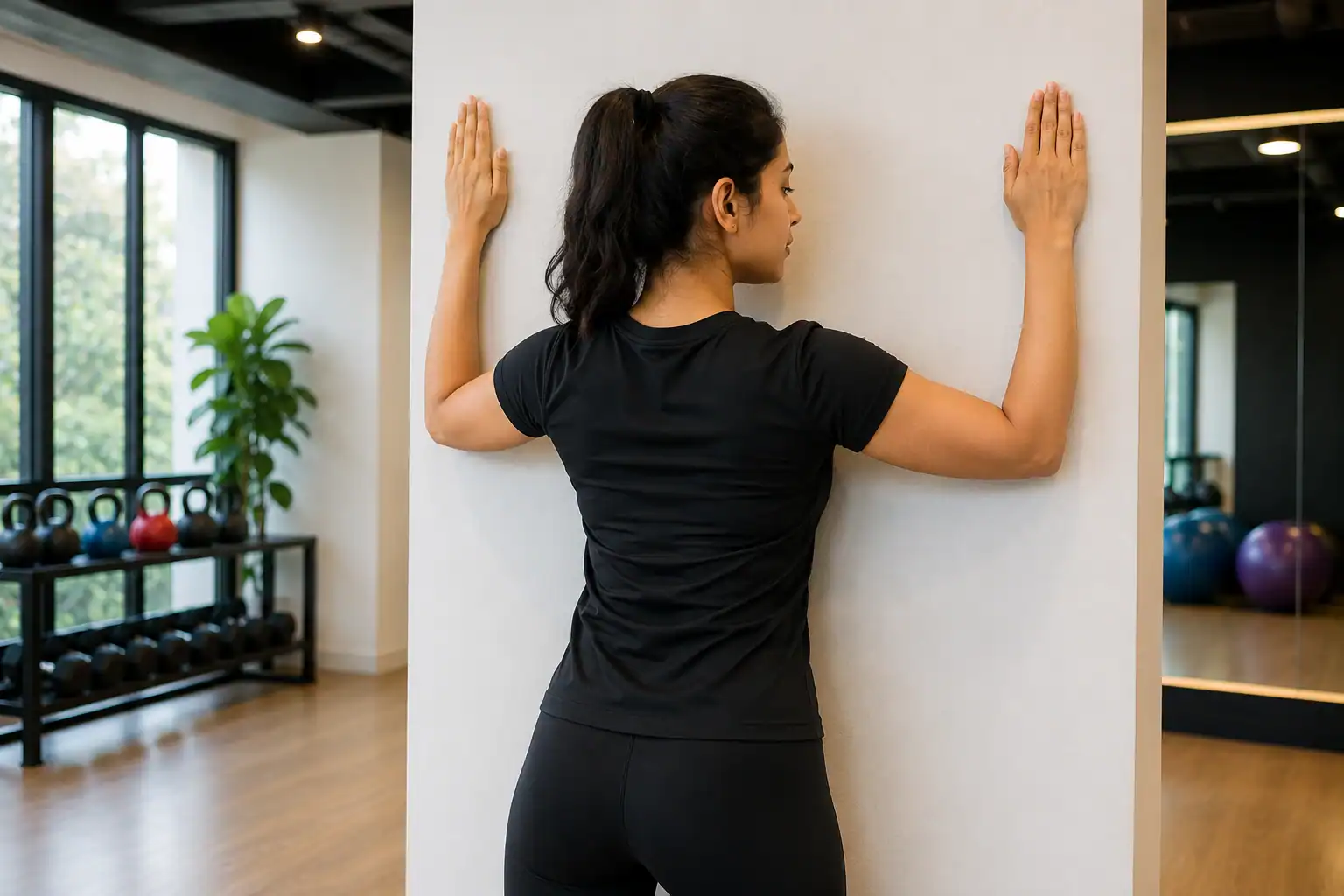
How to do it:
Stand with your back close to a wall. Keep your feet slightly away from the wall if that feels easier. Place your forearms on the wall in a goalpost shape. Slowly slide your arms upward as far as you can without pain. Then bring them back down.
Do 6 to 10 slow reps.
What it helps with:
Wall slides can support shoulder blade control, overhead movement, and posture awareness. A 2024 systematic review found that scapular stabilization exercises improved pain and function in people with subacromial pain syndrome, though range-of-motion improvement was not clearly better than control treatment [https://www.frontiersin.org/journals/neurology/articles/10.3389/fneur.2024.1357763/full].
That means we should not claim wall slides magically unlock the shoulder for everyone. But they are useful for practising smoother and more controlled movement.
Make it easier:
Slide only halfway up the wall.
Make it harder:
Add a very light resistance band only when the movement is completely pain-free.
Common mistake:
Arching the lower back or lifting the shoulders toward the ears.
Safety cue:
Stop if you feel sharp pain or pinching in the front of the shoulder.
4. Shoulder Pass-Through With Stick or Towel
This is one of the most searched variations because many people look for shoulder mobility exercises with stick, towel, or band.
You can use a broomstick, PVC pipe, yoga strap, dupatta, or towel.
How to do it:
Hold the stick or towel with a wide grip in front of your body. Keep your elbows straight but not aggressively locked. Slowly raise it overhead. If it feels comfortable, continue slightly behind your head. Then return to the front.
Do 5 to 8 slow reps.
Your grip should be wide enough that the movement feels smooth. If you need to bend your elbows or force the movement, your grip is probably too narrow.
What it helps with:
This movement helps you explore overhead range, shoulder flexion, and chest opening. Healthline also includes pass-through style movement in its shoulder mobility guide [https://www.healthline.com/health/shoulder-mobility-exercises].
Make it easier:
Use a towel and keep the grip very wide.
Make it harder:
Gradually narrow the grip over time, but only if it stays pain-free.
Common mistake:
Forcing the arms behind the body because online videos make it look easy.
Safety cue:
Do not push through pain, catching, pinching, or a feeling of instability.
Important note: some people call this movement “shoulder dislocates.” That name is common online, but the exercise should never feel like your shoulder is dislocating. Keep it gentle and controlled.
5. Doorway Chest Opener
A tight chest can make your shoulders feel rounded and restricted. The doorway chest opener is a simple stretch that pairs well with active mobility exercises.
How to do it:
Stand in a doorway. Place one forearm on the side of the doorway, with your elbow around shoulder height or slightly lower. Gently step forward until you feel a mild stretch across the chest and front of the shoulder.
Hold for 20 to 30 seconds. Repeat 1 to 2 times per side.
What it helps with:
This can help open the front of the chest, especially if you sit for long hours or spend a lot of time using a phone or computer.
Make it easier:
Keep your elbow lower than shoulder height.
Make it harder:
Hold the stretch a little longer, but do not increase pain.
Common mistake:
Leaning too hard and turning the stretch into shoulder pain.
Safety cue:
If you feel pinching deep inside the shoulder, reduce the range or skip it.
This is not the only solution for rounded shoulders, but it can be a useful part of a simple mobility routine. Later, this section can internally connect with your upcoming posture correction exercises article [Internal Link: /posture-correction-exercises/].
6. Band Pull-Aparts
Band pull-aparts are different from the earlier movements because they add light resistance.
This is useful because shoulder mobility is not only about stretching. Your shoulder also needs control and support from the upper back and shoulder blade muscles.
How to do it:
Hold a light resistance band in front of your chest with both hands. Keep your arms straight or slightly bent. Pull the band apart until your hands move away from each other. Think about gently squeezing your shoulder blades. Slowly return.
Do 8 to 12 reps.
What it helps with:
Band pull-aparts can support upper-back activation and shoulder blade control. This matches the broader evidence direction that active exercise, motor-control work, and resistance training can be useful in shoulder rehab and function when appropriately prescribed [https://www.jospt.org/doi/10.2519/jospt.2025.13182].
Make it easier:
Use the lightest band. If you do not have a band, practise shoulder blade squeezes without equipment.
Make it harder:
Add a second set or use slightly more tension, but only when your form stays clean.
Common mistake:
Using a band that is too heavy and shrugging the shoulders.
Safety cue:
Keep the movement smooth. Do not jerk the band.
This is the main exercise in this article that fits shoulder mobility band exercises.
7. Neck and Shoulder Mobility Flow
The neck and shoulders often feel connected. If your neck is tense, your shoulders may feel tight. If your shoulders are stiff, your neck may start doing extra work.
This gentle flow combines neck and shoulder movement without forcing either area.
How to do it:
Sit or stand tall. Slowly turn your head right and left within a comfortable range. Then gently tilt one ear toward one shoulder, return to centre, and repeat on the other side. Add slow shoulder rolls. Finish with gentle shoulder blade squeezes.
Move for 90 seconds to 2 minutes.
What it helps with:
This can help you relax the upper shoulder area and understand how your neck and shoulders move together.
Make it easier:
Move only halfway through the range.
Make it harder:
Slow the flow down and focus on breathing.
Common mistake:
Pulling the head with the hand or forcing neck range.
Safety cue:
Stop immediately if you feel dizziness, tingling, numbness, headache increase, or pain travelling down the arm.
This section supports people searching for neck and shoulder mobility exercises, but remember: neck symptoms can have many causes. Do not self-treat serious or worsening symptoms.
A Simple 10-Minute Shoulder Mobility Routine
Now let’s put the 7 shoulder mobility exercises into a simple routine.
You can do this at home, at the gym, before a dance workout, before light upper-body training, or as a short movement break during the day.
Minute 0–1: Shoulder Rolls
Do 5 to 8 slow circles backward and forward. Keep your breathing relaxed.
Minute 1–2: Arm Circles
Start small. Move both directions. Keep the shoulders relaxed.
Minute 2–3:30: Wall Slides
Do 6 to 8 slow reps. Keep the ribs controlled and avoid shrugging.
Minute 3:30–5: Stick or Towel Pass-Through
Do 5 to 6 controlled reps with a wide grip.
Minute 5–6:30: Doorway Chest Opener
Hold around 30 seconds each side.
Minute 6:30–8: Band Pull-Aparts
Do 8 to 12 reps with light resistance.
Minute 8–10: Neck and Shoulder Mobility Flow
Move slowly. Keep everything comfortable.
This routine is not magic. It works best when repeated consistently and adjusted to your body. A beginner may start with 3 days per week. Someone who sits a lot may do a shorter version daily. Someone with pain or injury should get individual guidance.
A smart progression is:
Range first.
Then repetitions.
Then light resistance.
Do not increase everything at once.
How Often Should You Do Shoulder Mobility Exercises?
For general stiffness, beginners can start with 5 to 10 minutes, 3 times per week.
If your shoulders feel tight because of long sitting, short daily movement breaks may also help. For example, you can do shoulder rolls, arm circles, and wall slides during a break from work.
But more is not always better.
If your shoulder feels irritated after every session, reduce the range, reduce the number of repetitions, or stop and get guidance. Mobility should leave you feeling more aware and comfortable, not more painful.
For workout preparation, dynamic movements like arm circles, shoulder rolls, and wall slides work well before exercise. Longer static stretches, like doorway chest openers, may feel better after a warm-up or at a separate time.
If you are doing strength training, dance fitness, or learning dance movements, shoulder mobility exercises can become part of your warm-up. For dance beginners, this can connect naturally with how to learn dance at home [Internal Link: /how-to-learn-dance-at-home/] because better shoulder movement can make arm styling and upper-body control easier.
Shoulder Mobility Exercises at Home vs Gym
You can do most shoulder mobility exercises at home. You do not need expensive machines.
At home, you can use a wall, towel, broomstick, doorway, light resistance band, and your own body awareness.
At the gym, you may have access to bands, cables, foam rollers, and trainer supervision. But equipment alone does not make an exercise better. Form matters more.
The best shoulder mobility exercises are the ones you can do correctly, consistently, and without pain.
For dancers, dance fitness students, and personal training clients, guided feedback can make a big difference. A trainer can notice things you may miss, such as rib flaring, shoulder shrugging, uneven range, moving too fast, or using too much resistance.
That is where guided mobility and personal training support in Silchar can help people who do not want to guess from videos.
Common Mistakes to Avoid
Many people do shoulder mobility exercises but still feel stuck because they repeat small mistakes.
The first mistake is forcing range. Mobility is not a fight. If your shoulder is guarding, pushing harder may irritate it more.
The second mistake is confusing pain with progress. A mild stretch can be okay. Sharp pain is not.
The third mistake is doing only stretches and no control work. Your shoulder needs movement, but it also needs stability and coordination.
The fourth mistake is ignoring the upper back. Shoulder movement often depends on thoracic mobility, shoulder blade control, and rib position.
The fifth mistake is copying advanced athletes. A gymnast, dancer, CrossFit athlete, or bodybuilder may do shoulder drills that are not right for a beginner.
The sixth mistake is expecting results in two days. Shoulder stiffness may improve quickly for some people, but others need weeks of consistent work, better strength, improved posture habits, and professional guidance.
The seventh mistake is using generic internet routines for diagnosed conditions. Frozen shoulder, rotator cuff tears, dislocations, and post-surgery recovery need different levels of care.
When Shoulder Stiffness Needs Professional Assessment
General stiffness is one thing. A shoulder problem is another.
You should stop these shoulder mobility exercises and get assessed if you notice sharp pain, worsening pain, sudden loss of movement, shoulder weakness, numbness, tingling, pain after a fall, a shoulder that looks out of place, night pain that does not settle, stiffness that does not improve, or a history of surgery.
Frozen shoulder is especially important. It is not just normal stiffness. NHS guidance says you should see a GP if shoulder pain and stiffness do not go away or if pain makes it hard to move your arm [https://www.nhs.uk/conditions/frozen-shoulder/].
A 2025 clinical practice guideline on primary frozen shoulder says self-stretching may be considered when appropriate, but it should be prescribed properly and followed with care [https://pmc.ncbi.nlm.nih.gov/articles/PMC12231400/]. Harvard Health also explains that frozen shoulder stretching often starts very gently and progresses slowly, because aggressive stretching can worsen symptoms [https://www.health.harvard.edu/pain/how-to-thaw-a-frozen-shoulder].
So please do not use this article as a frozen shoulder treatment plan. This guide is for general beginner-friendly mobility, not medical rehabilitation.
Guided Mobility and Personal Training Support in Silchar
If you are in Silchar and you feel unsure about doing shoulder mobility exercises on your own, guided support may be a better option than guessing.
At Rhythmics Dance and Fitness Studio, the focus is not only on dance. The studio also supports people who want better fitness, better body control, goal-specific personal training, and guided mobility work.
For someone with stiff shoulders, that may mean learning how to move safely, understanding your current range, correcting basic form mistakes, and building a routine that matches your lifestyle.
This can be useful if you are a beginner, a dancer with restricted arm movement, a fitness student returning after a break, someone with desk-job stiffness, or someone who wants personal training in Silchar with better form feedback.
This section should not sound like a medical claim. Rhythmics Dance and Fitness Studio is not being presented here as a hospital or diagnostic clinic. The right positioning is guided exercise, mobility support, movement coaching, and personal training.
For hands-on exercise guidance, explore guided mobility and personal training support in Silchar at Rhythmics Dance and Fitness Studio.
Contact: 7905026175
Address: Silchar
Booking Link: https://rhythmix.co.in
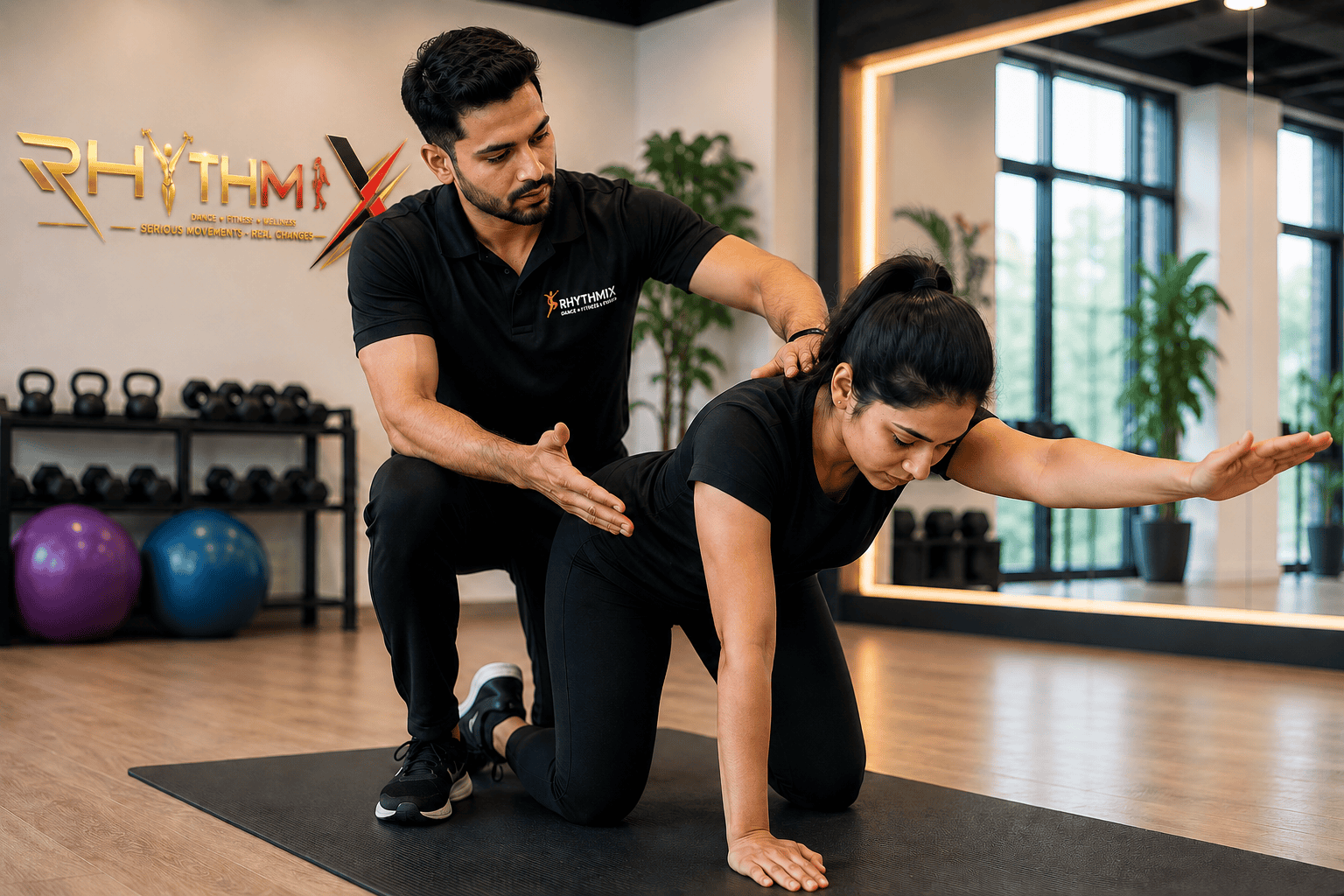
FAQs About Shoulder Mobility Exercises
What are the best shoulder mobility exercises?
The best shoulder mobility exercises for beginners are the ones that improve comfortable movement without pain. A good beginner set can include shoulder rolls, arm circles, wall slides, stick or towel pass-throughs, doorway chest openers, band pull-aparts, and a gentle neck and shoulder mobility flow.No single routine is best for everyone. Your body, activity level, pain history, and movement restriction matter.
Can beginners do shoulder mobility exercises at home?
Yes, many beginners can do shoulder mobility exercises at home if they have mild stiffness and no serious symptoms. Start with simple movements like shoulder rolls, arm circles, wall slides, and towel pass-throughs. Keep the movement slow and pain-free. If symptoms worsen, stop and get assessed.
How often should I do shoulder mobility exercises?
For general stiffness, beginners can start with 3 short sessions per week. A 5 to 10-minute routine is enough to begin. Some people may benefit from shorter daily movement breaks, especially if they sit for long hours. But if you have pain, injury, or a diagnosed condition, frequency should be guided by a professional.
Should I do shoulder mobility exercises before or after a workout?
Dynamic movements like arm circles, shoulder rolls, and wall slides can work well before a workout. Longer static stretches, like doorway chest openers, may be better after a warm-up or at a separate time. The goal is to prepare the shoulder, not tire it out before training.
Can shoulder mobility exercises help posture?
They may help you move and hold yourself with better awareness, especially if shoulder stiffness is making your posture feel restricted. But posture is not fixed by one exercise. Better posture usually needs a mix of mobility, strength, breathing awareness, work breaks, and habit changes.
Do I need a band or stick?
No. You can start without equipment.
A stick, towel, or band simply gives you more options. Stick or towel drills help overhead range awareness. Band pull-aparts add light strength and control. If you are a beginner, start with the easiest version first.
Are shoulder mobility exercises safe for frozen shoulder?
Do not treat general shoulder mobility exercises as a frozen shoulder plan. Frozen shoulder can involve significant pain, stiffness, and loss of range. It needs condition-specific guidance. Gentle movement may be part of care, but the exercise type, intensity, and timing should be guided by a qualified professional.
How long does it take to improve shoulder mobility?
There is no fixed timeline.
Some people feel better after a few sessions because they were simply not moving enough. Others need weeks or months because stiffness may be linked to strength, posture habits, pain, injury history, or a medical condition. Consistency matters, but so does doing the right exercise for the right reason.
Can dancers benefit from shoulder mobility exercises?
Yes. Dancers often need expressive arm movement, clean lines, overhead reach, shoulder control, and upper-body coordination.
Shoulder mobility exercises can support freer movement, especially when combined with dance training and proper warm-up. This can connect naturally with dance classes near me for people looking for guided dance training.
Can shoulder mobility exercises reduce shoulder pain?
They may help some people move more comfortably, especially if stiffness is related to lack of movement or poor control.
But pain has many causes. This article does not diagnose or treat shoulder pain. If pain is persistent, severe, worsening, or linked with weakness, numbness, trauma, or night pain, seek professional assessment.
Conclusion
Shoulder stiffness can quietly affect your workouts, dance, posture, sleep comfort, and daily life. The good news is that simple shoulder mobility exercises can help many beginners start moving with more awareness and control.
Start with easy movements. Stay pain-free. Do not force range. Add light strength when your body is ready. And if your shoulder feels painful, weak, unstable, or seriously restricted, do not guess—get assessed.
For people in Silchar who want hands-on support, Rhythmics Dance and Fitness Studio offers guided mobility and personal training support in Silchar, helping beginners learn movement with better form, confidence, and consistency.