
How to Learn Dance at Home: A Complete Guide for Beginners
Many people want to dance but never take the first step because they believe that learning dance requires a professional studio, expensive classes, natural talent or years of experience. The truth is much simpler: you can begin learning from wherever you are.
If you are searching for how to learn dance at home, you do not need to become an expert on your first day. You simply need a place where you can move comfortably, some music, a willingness to practise and a simple plan to follow.
Learning dance is a gradual process. Your rhythm can improve. Your coordination can improve. Your body control can improve. Even your confidence can improve with regular practice. The important thing is to stop thinking of dance as something that only naturally talented people can do.
When you understand how to learn dance at home, you can break the process into smaller and more manageable steps. Instead of trying to copy an entire difficult choreography, you can first learn basic movement. Then you can practise rhythm. After that, you can work on coordination, combinations and eventually longer dance routines.
Home practice also gives beginners something valuable: freedom to make mistakes. You can pause a tutorial, repeat the same movement ten times, practise slowly and start again without feeling embarrassed.
However, learning successfully is not about watching random videos every day. A structured approach is much more effective. This guide will explain how to learn dance at home step by step and help you build a practical foundation as a beginner.
You do not need to know everything before you start. You simply need to start with one movement and keep improving from there.
Can You Really Learn Dance at Home?
Yes, you can learn a great deal about dance from home. You can develop rhythm, coordination, body awareness, movement quality, musicality and the ability to remember dance combinations.
The important question is not whether it is possible. The important question is how to learn dance at home in a structured and effective way.
Some people make the mistake of opening a random dance video, attempting a difficult routine for fifteen minutes and then giving up because it feels too hard. This can make dance appear more difficult than it really is.
A better approach is to develop your skills gradually.
Start with movements that feel manageable. Learn how your body shifts weight from one foot to another. Practise moving with the beat. Understand simple counts. Then begin connecting movements.
This approach helps beginners develop confidence instead of feeling overwhelmed.
When learning how to learn dance at home, you also do not have to immediately choose one specific dance style. You can first develop general movement skills and later explore the styles that interest you.
The advantage of home learning is flexibility. You can practise at your own speed. You can repeat difficult movements without worrying about holding up an entire class.
At the same time, home practice requires consistency. Nobody will remind you to practise. You need to create your own routine.
That is why the following steps are important.
What Do You Need Before You Start Learning Dance?
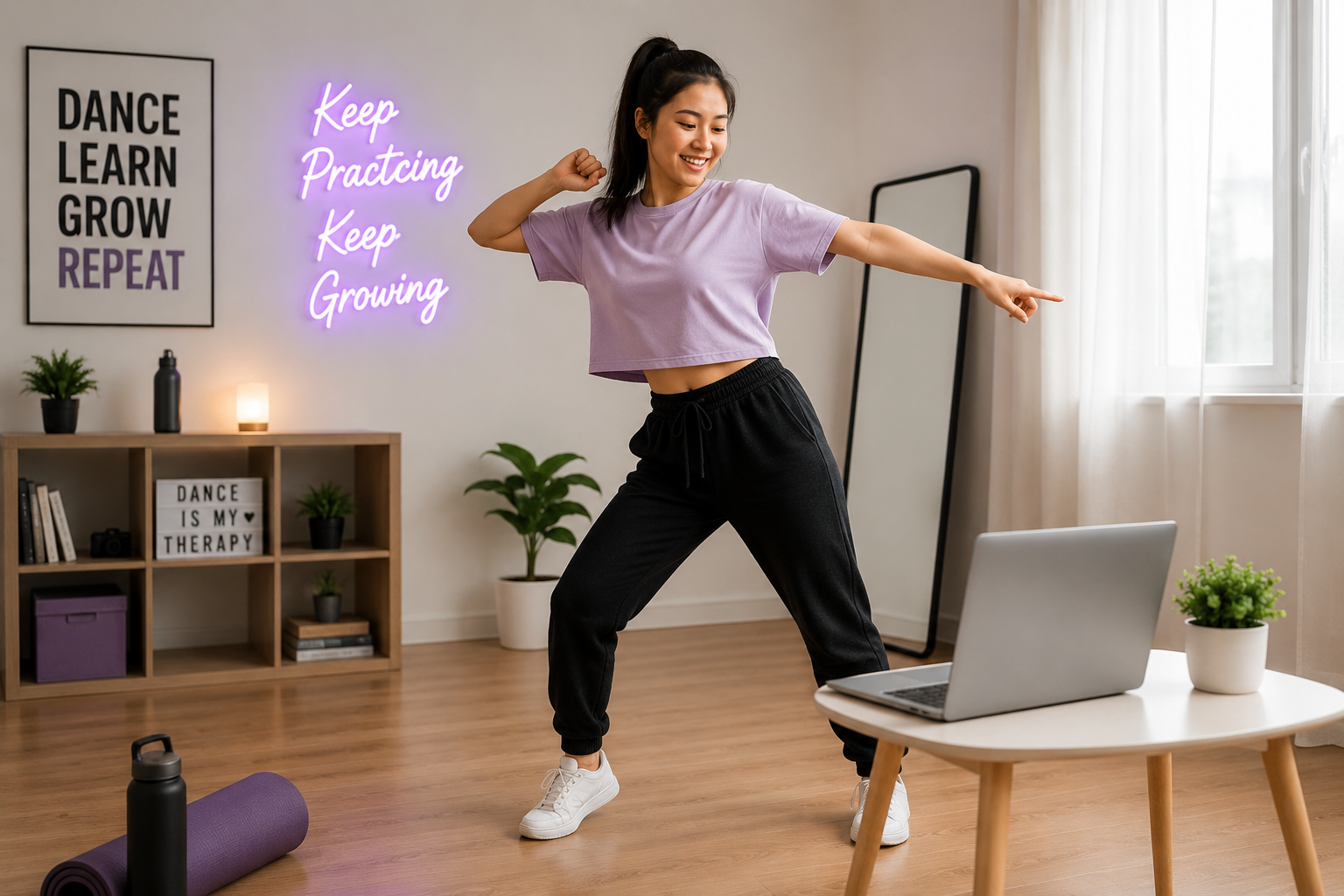
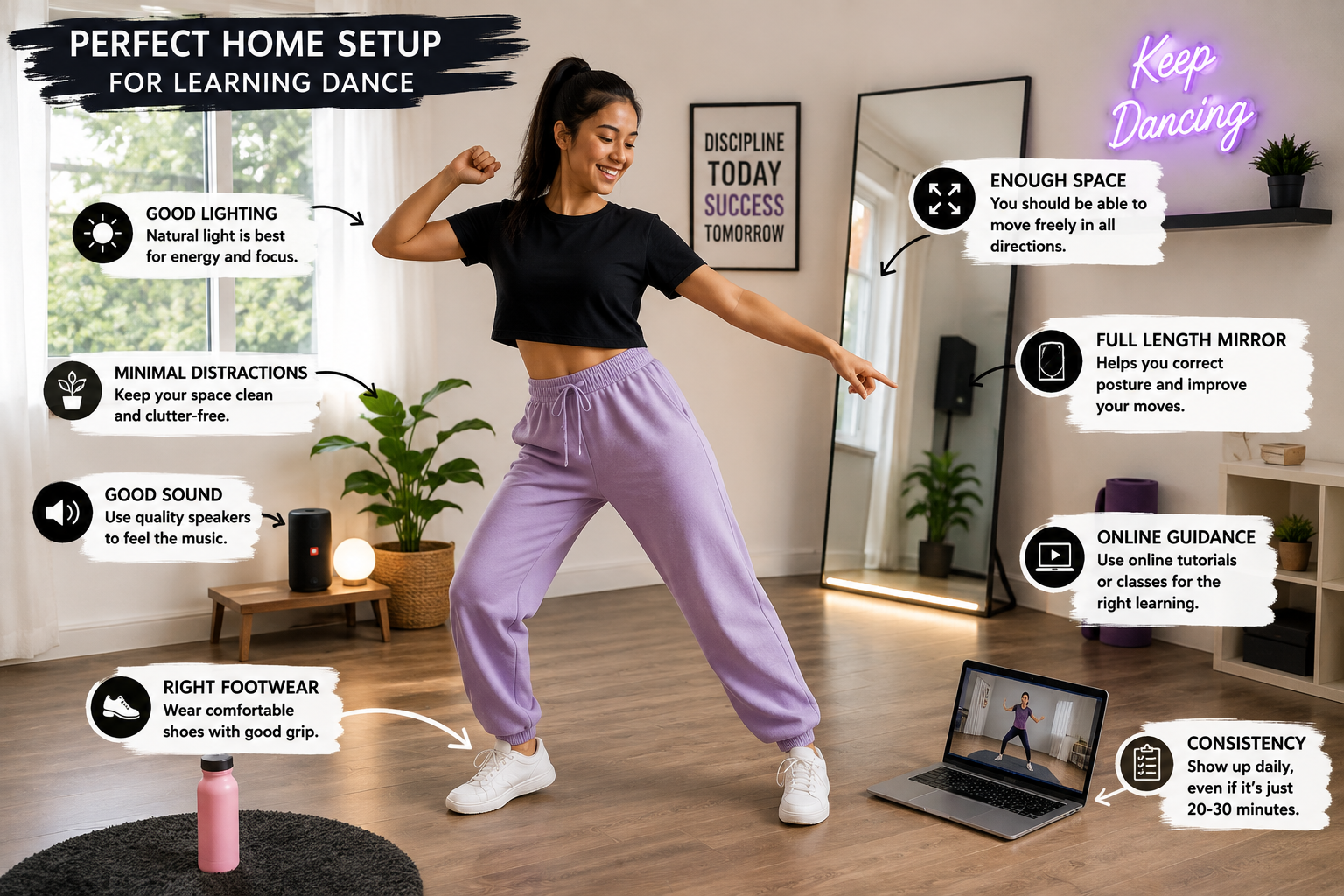
Before you begin learning how to learn dance at home, prepare a simple practice environment.
You do not need a professional studio. You simply need enough space to move safely.
Clear away objects that could get in your way. Make sure the floor is not unnecessarily slippery. Try to create enough room to step forward, backward and sideways without hitting furniture.
Wear comfortable clothing that allows you to move freely.
A phone, tablet, laptop or television can be useful if you are following dance tutorials. You may also find a mirror helpful, although it is not compulsory.
In fact, recording yourself can sometimes be more useful than constantly watching yourself in a mirror. A recording allows you to observe your movement after practising.
Choose music that is easy to follow at first. Songs with a clear beat can make rhythm practice easier.
When thinking about how to learn dance at home, remember that your setup does not need to be perfect. Waiting for the perfect room, mirror or equipment can become another reason to delay starting.
Start with what you have.
Step 1 — Start With Basic Dance Steps Instead of Difficult Choreography
One of the most important lessons about how to learn dance at home is to avoid beginning with choreography that is far beyond your current level.
Difficult routines may look exciting online, but they often require multiple skills at the same time. You may need to remember many movements, coordinate your arms and legs, maintain rhythm and move with a particular style.
For a beginner, that can feel overwhelming.
Instead, start with basic dance steps for beginners.
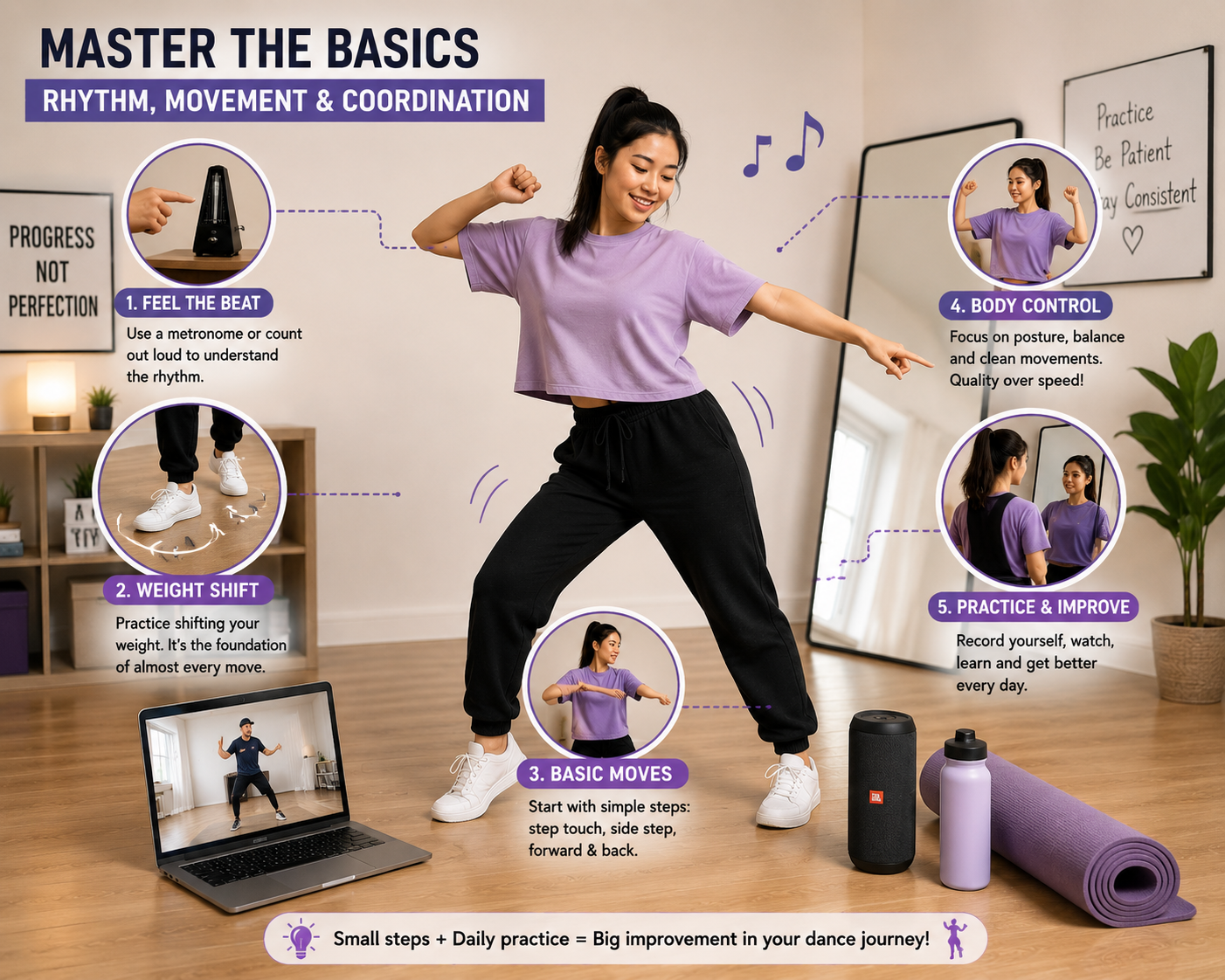
Practise simple movements such as stepping from side to side, moving forward and backward, shifting your body weight and changing direction.
At this stage, you do not need to worry about looking impressive.
Ask yourself three questions:
- Can I perform this movement comfortably?
- Can I repeat it without losing balance?
- Can I perform it while staying with the music?
Once the answer becomes yes, add another movement.
For example, begin with a simple side step. Repeat it several times. Then add an arm movement. Then try changing direction.
Small movements gradually become combinations.
This is one of the most practical ways to understand how to learn dance at home because your body develops familiarity before you add complexity.
Many beginners believe repetition is boring. In reality, repetition is one of the most important parts of learning.
The first time you perform a movement, your brain may need to consciously think about every detail. After repeated practice, the movement begins to feel more natural.
This is why easy dance steps for beginners are not something to skip. They create the foundation that makes more complicated movement easier later.
Step 2 — Learn How to Find the Rhythm in Music
Dance is not only about knowing movements. You also need to understand when to perform them.
This is where rhythm becomes important.
If you want to know how to learn dance at home, spend time listening to music instead of immediately trying to copy a dance.
Choose a song with a clear beat.
Before dancing, simply tap your hand or foot with the beat.
Then try counting:
1, 2, 3, 4.
Repeat the count while listening.
Once you can consistently identify the beat, begin adding a simple movement.
For example, step to the right on one count and return on the next count.
The goal is to connect movement with timing.
Start simple.
You do not need to understand complicated musical terminology to begin developing rhythm. You simply need to become more aware of the pulse of the music.
As you continue practising how to learn dance at home, you can begin noticing stronger beats, pauses, changes in energy and different sections of the song.
These musical changes can eventually influence the way you move.
Step 3 — Improve Your Body Movement and Coordination
Many beginners understand what a movement should look like but struggle when they try to perform it.
You may know where your feet should go, but then forget what your arms are supposed to do. This is a normal coordination challenge.
When learning how to learn dance at home, simplify the movement instead of repeatedly attempting everything at once.
First, practise the footwork.
Then stop.
Practise the arm movement separately.
After that, slowly combine the two.
You can also break a movement into counts.
For example:
Count 1: Step right.
Count 2: Bring the other foot in.
Count 3: Add the arm movement.
Count 4: Change direction.
Breaking movements into smaller sections makes them easier to understand.
Your body also has different areas that can move independently. Your shoulders, chest, hips, arms and feet do not always have to move in exactly the same way.
Try simple body-awareness exercises. Move your shoulders. Then practise shifting your weight. Try moving your chest gently in different directions.
Experiment with controlled hip movement.
The purpose is not to exaggerate every movement. The goal is to develop greater control. As your coordination improves, your dancing will gradually begin to feel less mechanical.
This is another important part of how to learn dance at home: improvement often happens through small corrections rather than one dramatic breakthrough.
Step 4 — Build a Simple Dance Practice at Home Routine
One of the biggest challenges when learning alone is inconsistency.
You may feel highly motivated on Monday and practise for an hour. Then you may not dance again for the next ten days.
A better strategy is to build a routine that fits your real schedule.
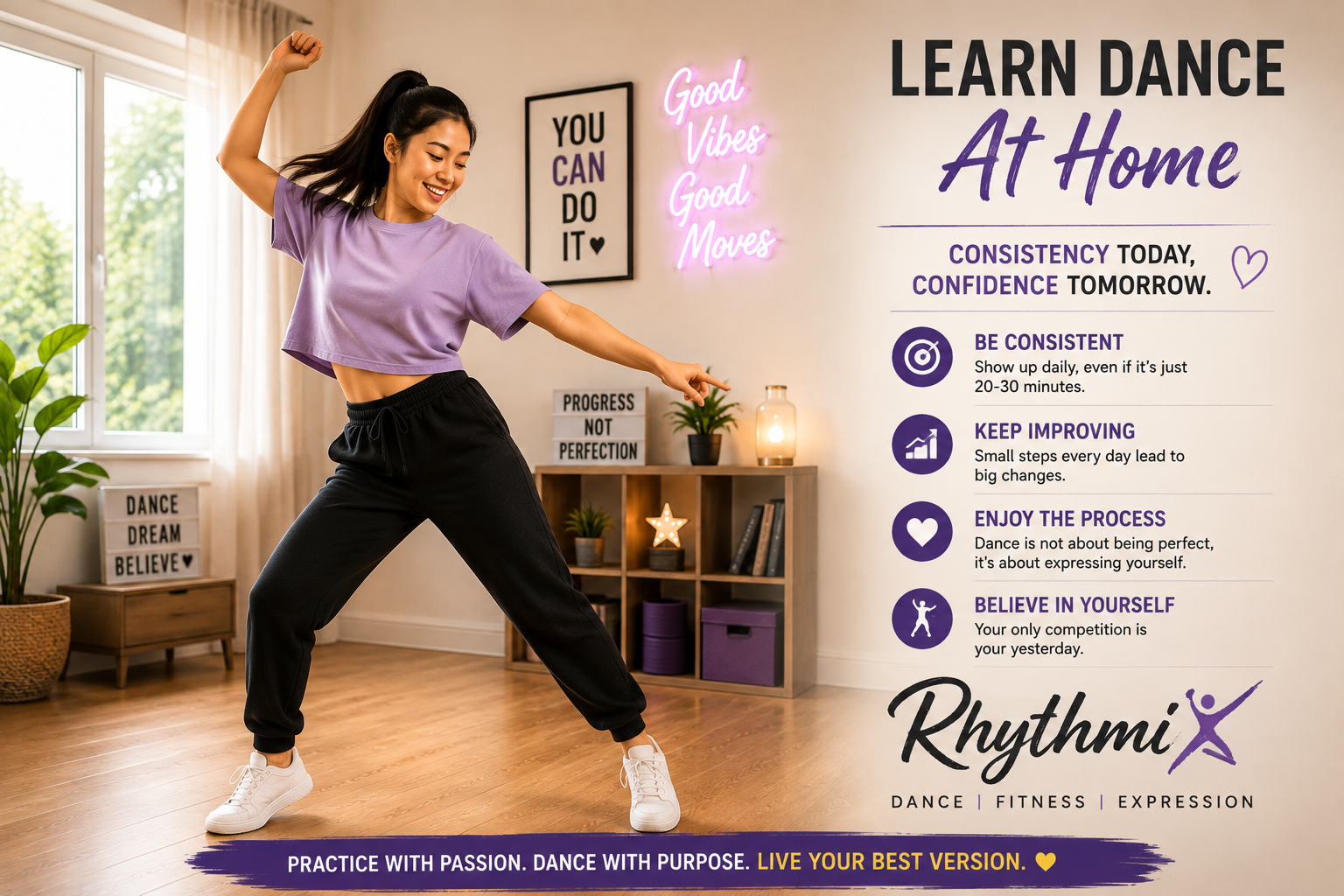
If you want to master how to learn dance at home, you do not need to practise for several hours every day.
A focused thirty-minute session can be enough for a beginner.
A Simple 30-Minute Practice Routine
5 minutes: Warm-up and light movement.
5 minutes: Rhythm and counting practice.
10 minutes: Basic movement practice.
5 minutes: Learn or review a short combination.
5 minutes: Repeat, review and cool down.
The goal is consistency.
The CDC recommends starting physical activity gradually and building it into a regular routine rather than expecting beginners to begin with extreme levels of activity.
Three focused practice sessions each week may be more sustainable than one extremely long session followed by complete inactivity.
When learning how to learn dance at home, choose a schedule you can realistically maintain.
Step 5 — Warm Up Before You Start Dancing
A proper warm-up is an important part of any active dance session.
If you immediately begin performing intense movements, jumps or fast choreography, your body may not be prepared for that level of activity.
A warm-up gradually prepares your body for movement.
The American Heart Association recommends warming up before exercise and cooling down afterward rather than suddenly starting or stopping intense activity.
Simple Dance Warm-Up Exercises
Before practising, you can begin with controlled movements such as:
- Walking or marching in place
- Gentle shoulder rolls
- Arm circles
- Light side steps
- Controlled hip movements
- Easy knee lifts
- Gentle bodyweight movements
The purpose is to gradually prepare for the movements you plan to perform.
If you are learning how to learn dance at home, do not treat warm-ups as an unnecessary extra step. Make them part of your routine.
After your practice session, gradually reduce the intensity rather than stopping suddenly.
Step 6 — Learn Short Combinations Before Full Choreography
You do not need to learn an entire dance routine in one session. In fact, trying to memorise too much at once can make the process harder.
When practising how to learn dance at home, divide choreography into smaller sections.
For example:
Move A → Move B → Move C → Move D
Practise these movements until you can perform them comfortably. Then add the next section.
A useful learning sequence is:
Watch → Understand → Practise slowly → Repeat → Add music → Increase speed.
Do not feel embarrassed about pausing a tutorial repeatedly. Pausing is part of learning. If the movement feels too difficult, slow the process down. Once you understand the movement, repeat it enough times for it to become familiar.
You can also record yourself. You do not need to share the video online. Use it as a learning tool.
You may notice that your footwork is correct but your timing is too early. Or perhaps you are forgetting to finish an arm movement.
These observations help you identify what to practise next.
Step 7 — Learn How to Dance to Any Song
A common question among beginners is how experienced dancers seem able to move naturally when they hear unfamiliar music.
They usually do not know a special move for every song.
Instead, they have developed movement vocabulary, rhythm awareness and confidence.
If you want to understand how to dance to any song, begin by listening before moving.
Ask yourself:
- What is the speed of the song?
- Where is the main beat?
- Does the music feel energetic or smooth?
- Are there obvious pauses?
- Does the song change energy?
Then choose simple movements that you already know.
Try performing the same movement to different songs.
You will begin to understand how music changes the feeling of movement. A simple step can look energetic with one song and relaxed with another. The more you practise this, the more comfortable you will become.
This understanding is an important part of how to learn dance at home because it moves you beyond simply copying choreography.
How to Learn Dance Fast Without Rushing Your Progress
It is natural to search for how to learn dance fast.
When you watch skilled dancers, it can appear as though they learned everything quickly. However, efficient learning and rushed learning are different. You can improve faster by identifying specific problems. Instead of repeating an entire routine for an hour, ask yourself what is actually causing difficulty.
Is your timing wrong?
Are you forgetting the footwork?
Are your arms disconnected?
Are transitions between movements difficult?
Once you identify the problem, practise that specific section.
Use a simple cycle:
Practise → Identify → Correct → Repeat.
This is much more effective than repeating mistakes without understanding them. When learning how to learn dance at home, some movements may feel impossible initially. Then, after repeated practice, they gradually become easier. That is why patience matters.
Common Mistakes Beginners Make When Learning Dance at Home
Understanding what not to do can be just as useful as learning what to do.
Trying to Learn Everything at Once
Do not attempt five completely different routines every day. Choose one skill or one combination and practise it properly.
Always Practising at Full Speed
Slow practice allows you to understand movement. If you cannot perform something slowly, making it faster will usually not solve the problem.
Ignoring Rhythm
Knowing movements is not enough if you consistently lose the beat. Spend time listening and counting.
Never Recording Yourself
Recording can help you see details that you may not notice while dancing.
Comparing Yourself Constantly
It is easy to compare yourself with professional dancers. Instead, compare your current practice with your own earlier progress.
Skipping Warm-Ups
If your practice involves vigorous movement, prepare your body gradually before increasing intensity. Avoiding these mistakes can make how to learn dance at home feel more manageable and structured.
A Simple 4-Week Plan to Learn Dance at Home
If you are unsure how to organise your practice, this beginner framework can help.
Week 1 — Build Basic Movement Awareness
Focus on simple steps.
Practise shifting your weight.
Learn to move forward, backward and sideways.
Spend time finding the beat.
Your goal is not difficult choreography.
Your goal is comfort with movement.
Week 2 — Improve Coordination
Continue practising basic steps.
Add arm movements.
Try combining upper-body and lower-body movements.
Work on staying with the beat.
This stage is particularly useful for beginners learning how to learn dance at home because coordination develops gradually.
Week 3 — Learn Short Dance Combinations
Choose a beginner-friendly combination.
Break it into small sections.
Practise each section slowly.
Then connect the movements.
Week 4 — Perform and Review
Try performing your routine without constantly watching the tutorial.
Record yourself.
Observe your timing, coordination and movement quality.
Identify what needs improvement.
Then continue practising.
This four-week plan is only a starting point. If you need more time at one stage, take more time.
Learning is not a competition.
How Much Should You Practise Dance at Home?
There is no perfect number of minutes for everyone. Your available time, fitness level, goals and experience all matter.
The most important thing is consistency. A beginner learning how to learn dance at home can start with shorter sessions and gradually increase the duration as they become more comfortable.
For example, twenty to thirty minutes of focused practice can be useful. During that session, avoid spending the entire time randomly switching between videos.
Choose a goal.
Perhaps today you want to improve rhythm.
Tomorrow you might focus on footwork.
The next session could focus on coordination.
This makes practice more intentional.
Can You Learn Dance at Home Without a Mirror?
Yes.
A mirror can be helpful, but it is not essential.
You can use your phone to record your practice. Then watch the video afterward.
Look at your posture, timing and movement.
Compare your practice with the movement you were trying to learn.
Another important skill is body awareness.
Over time, you begin to understand how a movement feels. This can help you make corrections even when a mirror is not available.
Do not delay learning how to learn dance at home simply because you do not have a perfect practice setup.
Start with the space and resources available to you.
How to Stay Motivated While Learning Dance at Home
Motivation changes.
Some days you will be excited to dance. Other days you may not feel like practising. That is why relying only on motivation is difficult.
Create small goals.
Instead of saying, “I want to become an amazing dancer,” try setting a goal such as:
“This week, I will learn one short combination and perform it comfortably with music.”
Specific goals are easier to follow.
You can also maintain a simple practice record.
Write down:
- What you practised
- What was difficult
- What improved
- What you will practise next
After a few weeks, you may be surprised by how much progress you can see.
This is one of the most useful approaches to how to learn dance at home because progress becomes visible.
When Should You Join a Dance Class?
Home learning can be an excellent starting point.
However, there may come a time when you want direct feedback.
An instructor can observe your movement and help you understand areas that may be difficult to identify yourself.
A structured environment can also provide regular practice, guidance and the opportunity to learn with other dancers.
You do not necessarily have to choose between learning at home and joining a class.
You can combine both.
Practise independently at home.
Then use professional classes for feedback and structured learning.
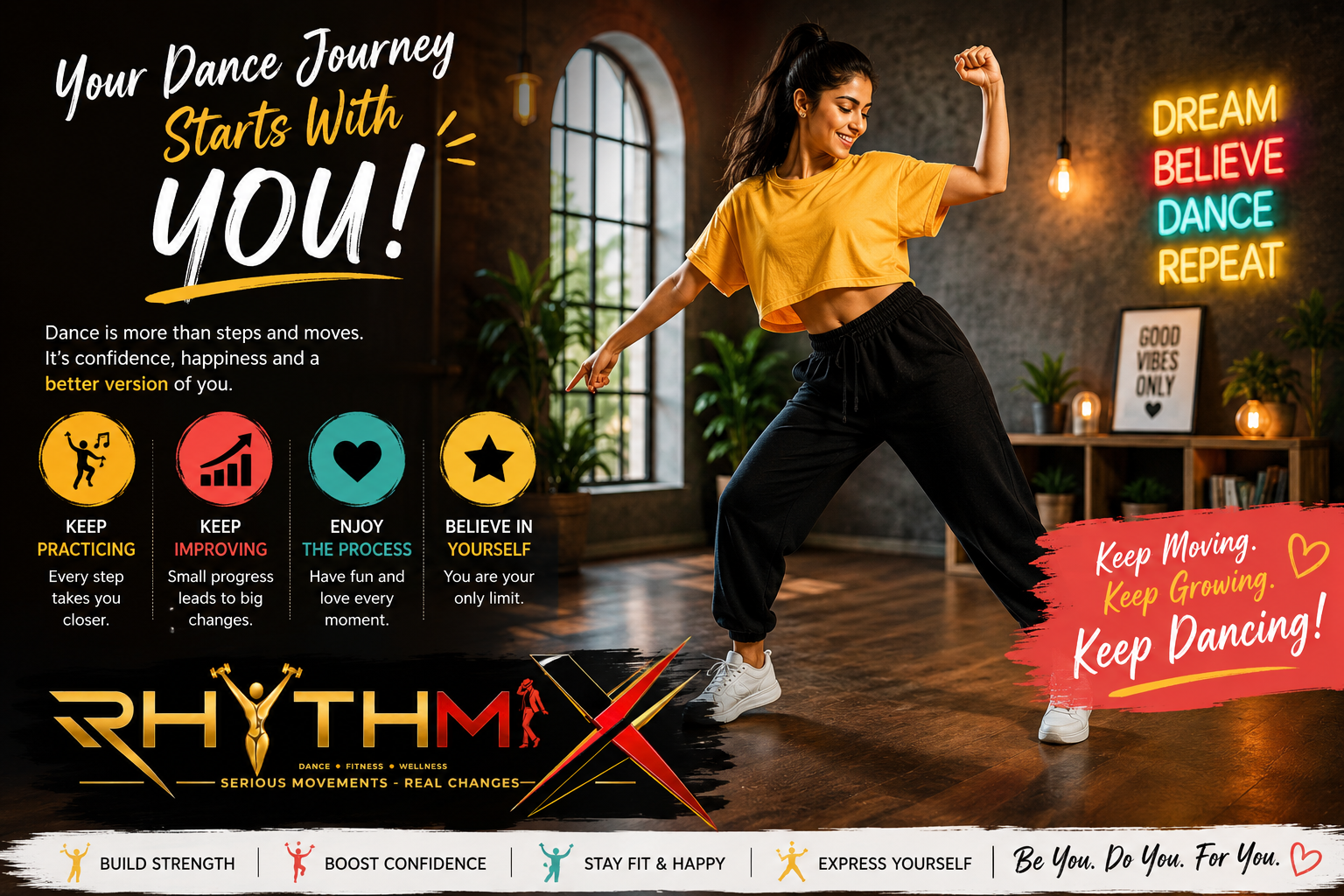
For people in Silchar who want to move beyond independent practice, Rhythmix can provide an environment for structured dance training.
How to Make Your Home Dance Practice More Effective
If you have been practising for some time but do not feel that you are improving, change the way you approach each session.
Start with a specific purpose.
For example:
“Today I will improve my rhythm.”
Or:
“Today I will practise this footwork until I can perform it without watching the screen.”
Or:
“Today I will focus on making my arm movements more controlled.”
Specific goals create more focused practice. You should also revisit movements you learned earlier. Something that felt difficult two weeks ago may now feel much easier. That is evidence of progress.
If you want to understand how to learn dance at home, remember that improvement is often gradual.
You may not notice major changes every day. But consistent practice can produce visible differences over weeks and months.
Safety Tips When Learning Dance at Home
Dance can range from gentle movement to physically demanding activity.
Choose movements appropriate for your current ability.
Keep your practice area clear.
Be careful on slippery floors.
Start gradually rather than immediately attempting advanced jumps, fast turns or high-impact movements.
Listen to your body.
If a movement causes significant pain, stop.
If you have a health condition, injury or concern about beginning a new physical activity routine, seek appropriate professional advice.
The purpose of learning how to learn dance at home is to build skill gradually and sustainably.
Frequently Asked Questions
Can I learn dance at home as a complete beginner?
Yes. A complete beginner can start with basic movement, rhythm exercises and simple dance combinations.
The best approach is to begin slowly and gradually increase difficulty.
How long does it take to learn dance at home?
The answer depends on your goals, practice frequency, previous experience and the type of dance you are learning. Basic improvement may become noticeable with regular practice, while developing stronger technique and movement quality takes longer.
What is the best way to learn dance at home?
The best method is to start with basic movements, practise rhythm, improve coordination, learn short combinations and repeat consistently.
How many days a week should I practise?
Choose a realistic schedule that fits your life. Several focused sessions each week may be easier to maintain than occasional extremely long practice sessions.
Can I learn dance without watching tutorials?
Yes. Tutorials can be useful, but you can also practise rhythm, body movement, freestyle and combinations that you create yourself.
How do I stop feeling awkward while dancing?
Most beginners feel awkward because the movements are unfamiliar. Regular repetition helps movements become more natural.
Should beginners learn fast or slow choreography?
Start with choreography that allows you to understand the movement clearly. Once you can perform it correctly and comfortably, gradually increase the speed.
Can I improve my rhythm?
Yes. Start with songs that have a clear beat. Tap, clap or step along with the music. Then gradually add movement.
Is learning dance at home enough to become a good dancer?
Home practice can build many important skills. Professional instruction and structured classes can also provide feedback and guidance when you are ready to progress further.
Conclusion — Start Learning Dance One Step at a Time
Learning how to learn dance at home does not mean you need to become an expert overnight.
You simply need to begin.
Create some space.
Choose a song.
Warm up.
Learn one movement.
Find the beat.
Repeat.
Then add another movement.
The process may feel slow at first, but every dancer starts somewhere.
If you are serious about how to learn dance at home, focus on consistency instead of perfection. Build your rhythm. Improve your coordination. Learn basic movements. Practise short combinations. Record yourself and identify areas for improvement. Or if you are from Silchar, You can take Professional Dance classes by Rhythmix.
Most importantly, do not wait until you feel completely ready.
Confidence often develops after you begin—not before.
Home practice can provide a strong foundation. And when you want feedback, structured learning and the experience of practising with other dancers, you can take the next step toward professional guidance.
Start with one movement today.
Then practise again tomorrow.
That is how every dance journey begins.